A flue is the internal passage that carries smoke and combustion gases out of the chimney. Three distinct problems bring San Francisco homeowners to flue work: a blockage, a damaged liner, or an unused flue that needs…
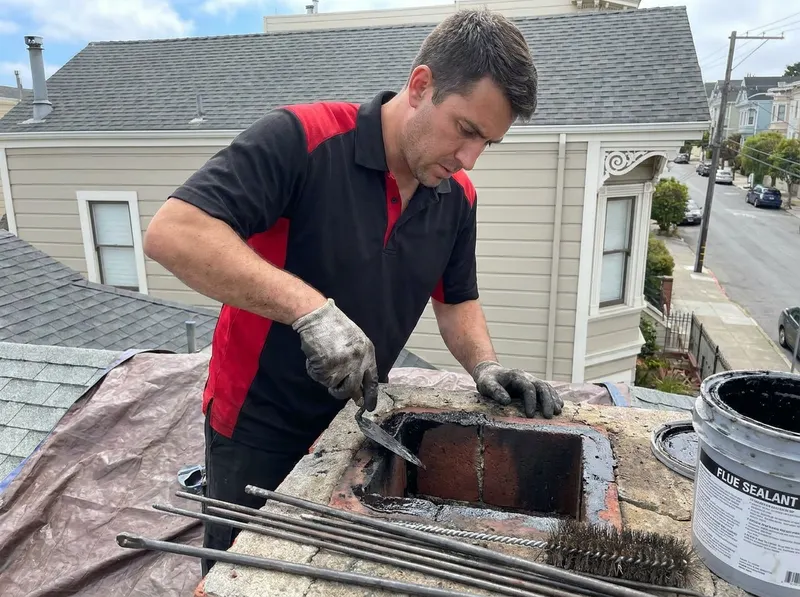
A flue is the internal passage that carries smoke and combustion gases out of the chimney. Three distinct problems bring San Francisco homeowners to flue work: a blockage, a damaged liner, or an unused flue that needs sealing. A clogged flue in a wood-burning fireplace is usually creosote glaze, a bird or squirrel nest, or fallen tile shards, and it shows up as smoke pushing back into the room, a strong odor, or a draft that stalls. If the reason is "i got my flue clogged," clearing plus a camera scan confirms whether the tile behind the debris is intact or cracked. Clearing is mechanical; relining is structural, the two are priced separately.
Chimney relining fits when the camera shows cracked, gapped, or spalled clay tiles. NFPA 211 treats a liner with breaches as a fire and carbon-monoxide hazard, because heat and gas can reach the framing. A stainless steel liner is the common fix for older masonry stacks across Noe Valley, Bernal Heights, and Glen Park, where 1900s-era clay flues shift with hillside settling. A cast-in-place liner suits severely deteriorated brick chimneys in Pacific Heights and Presidio Heights that also need structural reinforcement. The trade-off: stainless installs in one day and carries a long product warranty; cast-in-place costs more and takes longer but rebuilds the flue wall itself.
Sealing off a flue is a separate service from repair. If the request is "i want to seal it off", a fireplace that is never used, or one converted to gas or decorative, a stainless top-sealing damper or a masonry cap-off closes the flue against rain, downdrafts, and nesting animals. In the fog-heavy Sunset District and Richmond District, an open unused flue draws damp salt air that corrodes the smoke shelf and stains interior walls; a cap-off stops that. For homes near Sea Cliff and the Marina exposed to coastal wind, a top-mounted sealing cap also cuts the whistling downdraft that plagues tall exterior chimneys.
The process runs in order: 1) inspect and camera-scan the flue to grade the blockage or liner damage; 2) share photos and a written scope so the reason and price are clear before any work; 3) clear the clog, install the liner, or set the seal; 4) re-scan and re-test draft to confirm the flue is clear or fully closed. A Level 2 inspection, the CSIA and NFPA 211 standard that includes a video scan, is recommended before relining and after any chimney fire or property sale. A Level 1 inspection covers routine readily-accessible checks.
One edge case worth naming: not every smoke problem is a clog. A short flue, a fireplace opening too large for the flue diameter, or a negative-pressure home can mimic a blockage, so clearing alone will not fix it. The camera scan separates a true obstruction from a sizing or draft issue before money is spent. To confirm which service applies, a free on-site estimate measures the flue and reports the actual condition. Yes, this is a chimney company; flue cleaning, liner work, and sealing are the core of what a sweep does.
Every job gets a firm, written price after a free on-site visit.
Tell us about your flue repair & sealing job in San Francisco and we'll send a clear, written quote, usually the same day.
 Hearthhero Chimney Sweep